Entretien des bottes en cuir : Huiles, cires et crèmes nourrissantes comparées
Quand nourrir avec un baume léger, quand imperméabiliser avec une cire et pourquoi un excès d'huile assouplit le cuir de façon irréversible : le guide complet.
The fundamental rule: cleaning before conditioning
Among footwear enthusiasts, the instinct to reach for a tin of conditioner whenever boots look dull is almost universal. Yet applying nourishing oils or waxes directly over surface grime is one of the most common causes of premature leather degradation. Dust, microscopic road grit and pavement salt act as fine abrasives. When trapped beneath a fresh layer of conditioning balm, they work into the pore structure and flex points of the leather with every step, gradually sawing through delicate grain fibres and weakening welt stitching.
A thorough dry cleaning should always precede any liquid or cream application. Use a 100% natural horsehair brush to sweep away loose dirt, paying particular attention to the welt seam, gusseted tongue and heel counter. If the boots have encountered mud, road salt or dried slush, wipe them down thoroughly with a microfibre cloth wrung out in lukewarm water, or employ a pH-balanced, non-detergent leather cleaner. Crucially, allow the leather to air-dry completely at room temperature on cedar shoe trees for at least 12 to 24 hours before introducing any conditioning agent. Conditioning damp leather traps internal water, leading to mould growth, fibre stiffness and rot.
Light conditioning creams: hydration without altering leather colour
When the goal is to replenish lost moisture without dramatically darkening lighter hides or leaving a heavy, sticky residue, light conditioning creams are the tool of choice. Formulated as delicate oil-in-water or wax-in-water emulsions (such as Bickmore Bick 4, Venetian Imperial Leather Balm, or Saphir Médaille d’Or Renovateur), these products penetrate the upper corium fibres quickly, restoring flexibility to dehydrated collagen bundles.
The primary advantage of light conditioning balms is their aesthetic neutrality. If you own tan, natural veg-tan, caramel or cognac footwear, heavy animal fats like mink oil will permanently darken the leather by several shades. A quality emulsion cream preserves the original tonal gradation while providing sufficient hydration to prevent surface flaking and stress fractures across the vamp.
Apply a dime-sized amount to a clean cotton cloth, massaging it into the leather in gentle circular motions. Let the cream absorb for fifteen minutes, then buff briskly with a clean horsehair polishing brush to reveal a soft, natural satin sheen.
Aniline and full-grain leathers: gentle nourishment without suffocating the grain
Different tanning methods demand tailored care philosophies. Premium full-grain leathers that have undergone minimal chemical correction or heavy acrylic top-finishing rely entirely on their natural fibrous structure and natural oils for flexibility and water repellency.
Because high-grade full-grain calf and cowhides possess natural breathability, heavy petroleum-based greases or synthetic silicone sprays are counter-productive. They clog pores, prevent the leather from exchanging moisture vapour, and can permanently darken lighter shades of brown or tan. Instead, a periodic application of a pH-neutral conditioning cream (such as Bick 4 or a light lanolin-based emulsion) maintains the leather's elasticity without compromising its natural texture or blocking its breathability.
For unlined or lightly lined leather footwear, wiping the interior occasionally with a damp cloth and ensuring boots air-dry thoroughly on cedar shoe trees prevents internal perspiration salts from stiffening the leather over years of regular rotation.
Heavy oils and greases: extreme weatherproofing and deep replenishment
At the opposite end of the spectrum lie heavy boot oils and greases, including pure neatsfoot oil, mink oil, Huberd’s Shoe Grease and beeswax-heavy compounds like Obenauf’s Heavy Duty LP. These formulations are composed of dense animal and plant fats designed to deeply saturate leather fibres and establish an impermeable barrier against standing water, snow and aggressive winter road salts.
While heavy oils provide peerless weather resistance for logging, construction and field boots, they come with substantial trade-offs that make them unsuitable for everyday casual or dress boots. Firstly, they permanently darken almost any leather they touch, often turning rich russet or copper shades into flat dark brown or black. Secondly, heavy oils soften leather dramatically. While this can ease the break-in of a rigid 3 mm industrial work boot, applying heavy oils to a structured dress boot or service boot can cause the ankle shaft to collapse into a limp, shapeless mass.
Finally, oily surfaces act as magnets for dry dust and grit. Reserve heavy greases strictly for winter work footwear or dedicated foul-weather boots exposed to extreme mud and continuous rain.
Oil-tanned work leathers: balancing toughness, pull-up and patina
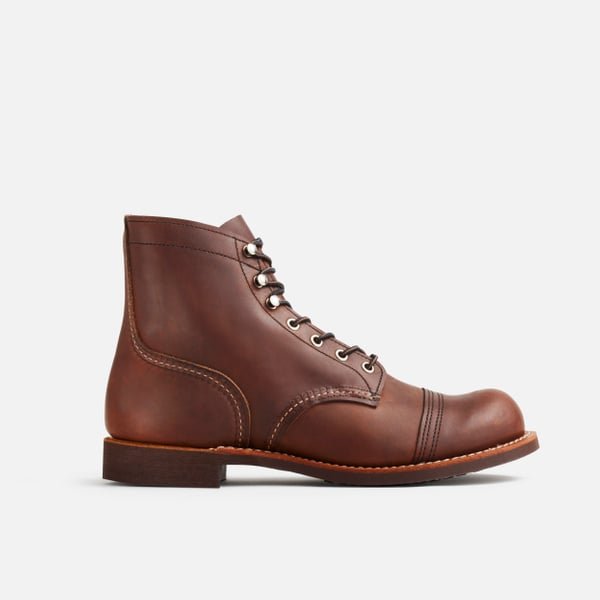
Oil-tanned leathers, such as Red Wing’s famous Amber Harness on the Iron Ranger 8111 or Briar Oil Slick on the Classic Moc, undergo extensive fatliquoring and hot-stuffing with oils and waxes during the tanning process. Because these hides already contain high concentrations of internal lubricants, they require much less conditioning than dry-tanned leathers.
Owners of oil-tanned boots frequently err by over-applying liquid oils, which saturates the pull-up effect—the striking colour variation created when internal oils migrate beneath the surface under pressure. To preserve this distinctive heritage character without causing excessive darkening, use an all-natural boot oil or neatsfoot cream sparingly once or twice a year, buffing thoroughly to restore the matte, rich luster.
When scuffs occur on oil-tanned hides, vigorous friction with a horsehair brush or warm thumb pressure is often sufficient to redistribute the internal waxes and diminish the mark without needing any conditioning product at all.
- Red Wing Heritage — Iron Ranger 8111 in Amber HarnessIconic American cap-toe service boot built from heavyweight oil-tanned leather, Goodyear welt and Vibram 430 mini-lug sole.
Waxes and paste polishes: surface protection versus breathability
It is crucial to distinguish between conditioners (which penetrate deep into the hide to nourish collagen fibres) and hard waxes (which sit on the surface to form a sacrificial protective shell). Paste waxes based on carnauba and beeswax provide excellent resistance to light scuffs and shallow rain puddles, while offering the capability to buff up to a high mirror shine.
However, hard wax must never be applied to the flexing regions of a boot—specifically across the vamp crease behind the toe cap. As your foot bends during walking, hard dried wax will shatter, producing unsightly white chalky lines deep inside the creases that are difficult to scrub away. Furthermore, accumulated layers of wax clog the breathability of the leather, trapping foot perspiration inside.
Best practice dictates using waxes exclusively on rigid, non-flexing sections: the hard toe cap, the heel counter, and the exposed leather sole edges and heel stacks to seal them against ground moisture.
The dangers of over-conditioning: signs and rescue protocols
More quality leather boots are ruined by well-intentioned over-conditioning than by neglect. When leather is oversaturated with oils, several destructive failure modes occur:
The fibrous structure becomes spongy and loose, losing its tensile strength and structural memory. Eyelets can pull out under lacing tension, and welt stitching can rot from anaerobic moisture trapped inside the saturated welt seam. In humid conditions, excess fat liquoring manifests as spew (or efflorescence)—a chalky white crystalline residue of expelled fatty acids rising to the leather surface.
If your boots feel mushy, greasy or exhibit fatty spew, halt all conditioning immediately. Scrub the boots thoroughly using a lather of traditional saddle soap and warm water to strip excess oils, wipe with a damp towel, and allow the boots to rest on unfinished cedar shoe trees in an airy, dry room for 48 hours. Once dry, resume only minimal brushing.
Seasonal care matrix and maintenance checklist
To establish a sustainable, effective care routine, follow this simple cadence based on real wear rather than arbitrary calendar dates:
- Every wear: Insert unfinished cedar shoe trees immediately upon removing your boots to absorb moisture and maintain vamp shape. Give the uppers a 30-second sweep with a horsehair brush.
- Monthly: Inspect the leather along the flex points and welt edge. If the grain feels dry, powdery, or shows light greyish stress lines, apply a dime-sized amount of light neutral conditioning cream.
- Every 3 to 6 months: Conduct a deep clean. Wipe with a damp cloth, let dry completely, apply appropriate conditioner (light cream for dress and artisanal leathers; neatsfoot or leather oil for heavy work hides), and buff vigorously.
- Annually or pre-winter: Treat sole edges and heel stacks with edge dressing or neutral wax polish to protect exposed leather midsoles from road slush and salt intrusion.
- Golden rule: When in doubt, brush more and condition less. Vigorous brushing warms and redistributes internal oils without adding unnecessary moisture or altering leather colour.