Paraboot Heritage-Schuhe: Michael und Chambord im Vergleich
Ein ausführlicher Leitfaden zu den französischen Ikonen von Paraboot – Zwiegenähte Machart, hauseigene vulkanisierte Naturkautschuksohlen, gewachstes Lis-Leder und Passformtipps.
The French Alpine legacy: from latex rubber to cult footwear
In the landscape of European heritage footwear, few makers occupy a niche as distinctive or uncompromising as Paraboot. Founded in 1908 by master cordwainer Rémy-Richard Ponvert in the small town of Izeaux, nestled in the Isère valley of south-eastern France, the company began by manufacturing sturdy wooden-soled clogs and work boots for agricultural labourers and Alpine timber cutters.
The decisive turning point arrived during an exploratory voyage to North America in 1926. Observing the emergence of vulcanised rubber overshoes, Richard-Ponvert conceived the radical idea of marrying traditional stitched European leather uppers directly with durable, waterproof latex soles. Upon his return to France, he sourced raw natural latex directly from the Amazonian port of Belém do Pará—a geographic connection immortalised in the portmanteau brand name: 'Para' plus 'boot'.
For decades, Paraboot's footwear was prized almost exclusively by Alpine foresters, postmen, tradespeople, and mountain walkers who required impenetrable weatherproofing on rocky slopes. However, during the 1980s, the brand underwent a dramatic cultural resurgence. Adopted first by the stylish Parisian 'Bon Chic Bon Genre' (BCBG) movement, and later embraced by Italian connoisseurs and Tokyo menswear circles, models like the Michael and Chambord evolved from rugged occupational workwear into celebrated pillars of contemporary casual style.
Norwegian welting and in-house rubber: engineering resilience
What sets Paraboot apart from the vast majority of heritage footwear producers is an unwavering commitment to two rare manufacturing disciplines: genuine Norwegian welt construction and in-house rubber vulcanisation.
While the overwhelming majority of Goodyear-welted dress shoes fold the upper leather downwards beneath the insole—creating a neat, formal edge that remains vulnerable to puddle seepage—the Norwegian welt (or cousu norvégien) takes an Alpine approach. The upper leather is turned outwards over the horizontal welt. A first heavy, waxed horizontal stitch anchors the turned-out upper directly into the ribbed insole, while a second vertical stitch bonds the welt to the leather midsole and outsole. This produces an exceptionally robust, storm-tight barrier that prevents moisture from penetrating the footbed, framed by two prominent parallel lines of exposed contrast stitching along the shoe perimeter.
Equally remarkable is Paraboot’s proprietary sole manufacture. In an era where even prestigious bench-makers outsource soling to Vibram or Dainite, Paraboot remains one of the only footwear brands in Europe to compound, pour, and cure its own outsoles. At their modern atelier in Saint-Jean-de-Moirans, raw Hevea tree latex is vulcanised into dense, shock-absorbing rubber outsoles engineered for longevity:
- Marche II sole: A deep, multi-directional lugged rubber sole fitted to the Michael, offering generous air-cushioned resilience and surefooted traction across wet flagstones, gravel, and autumn leaves.
- Tex sole: A slightly lower-profile, denser natural rubber sole utilised on the Chambord, featuring a subtle tread pattern that preserves a sleek side profile while delivering superior wet-weather grip.
- Griff II sole: A refined, ribbed rubber sole often reserved for split-toe derbies like the Avignon, balancing formal elegance with all-day pedestrian durability.
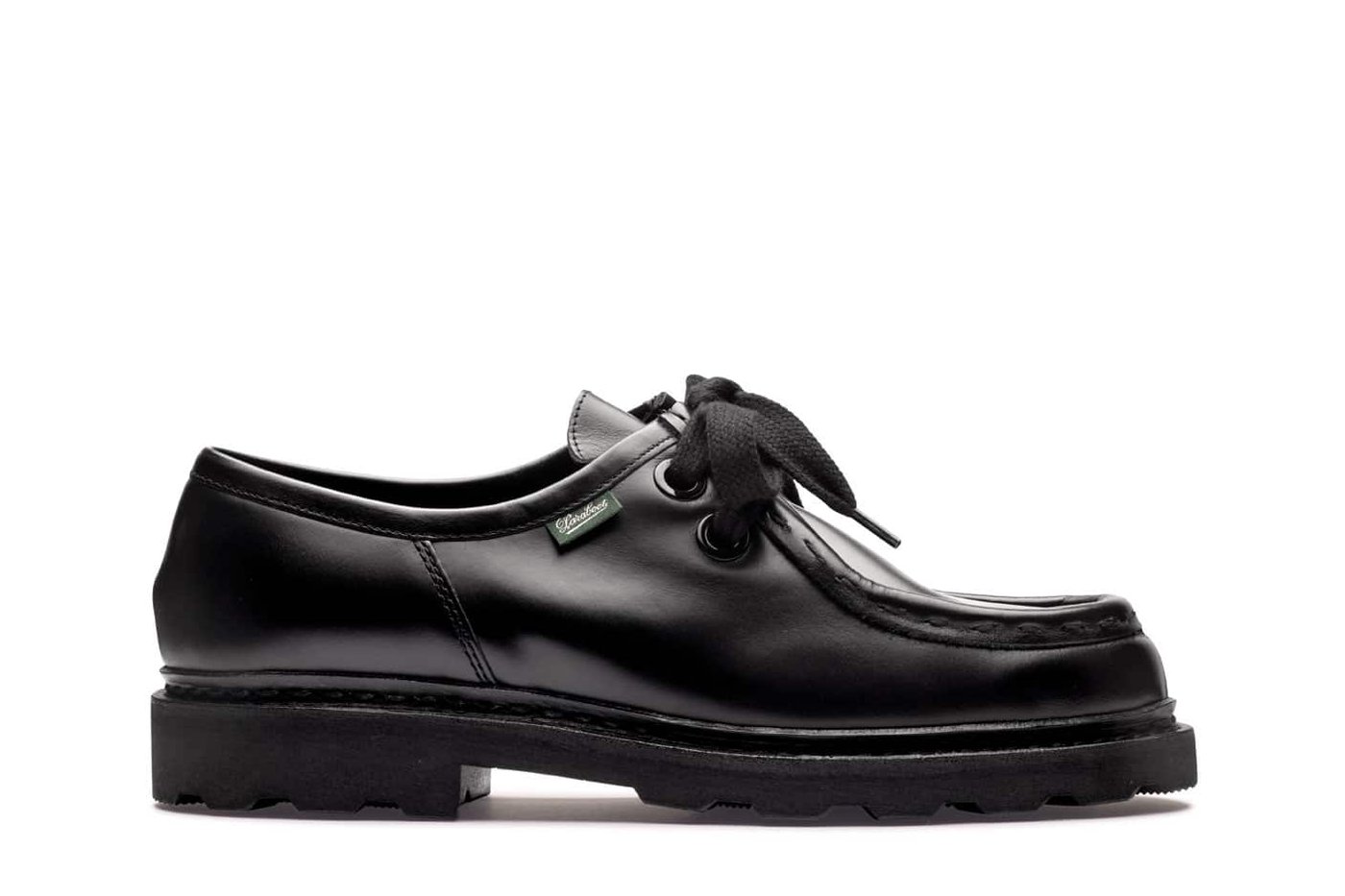
The Michael: the archetypal Tyrolean derby
First unveiled in 1945, the Michael was designed by Julien Richard (the founder's son) to commemorate the birth of his own son, Michel. Rooted in traditional Tyrolean walking shoes originally developed for Austrian and Alpine hunters, the Michael broke completely with conventional derby aesthetics.
Defined by its chunky silhouette, heavy piped apron seam, and minimalist two-eyelet blucher lacing, the Michael is immediately recognisable on foot. The two-eyelet closure allows the heavy calfskin vamp to flex cleanly without pinching, while the padded collar provides comfortable ankle cushioning. The voluminous forefoot ensures unconstrained toe splay, making it an extraordinarily comfortable option for long days on hard urban pavements.
Stylistically, the Michael possesses an uncommon chameleon-like quality. Its bold, rugged proportions effortlessly anchor wide-leg selvedge denim, heavy corduroy trousers, and relaxed tweed overcoats, yet it sits with equal confidence beneath cropped, tailored wool flannel trousers. It is intentionally unorthodox—a tactile statement piece that defies fleeting seasonal trends.
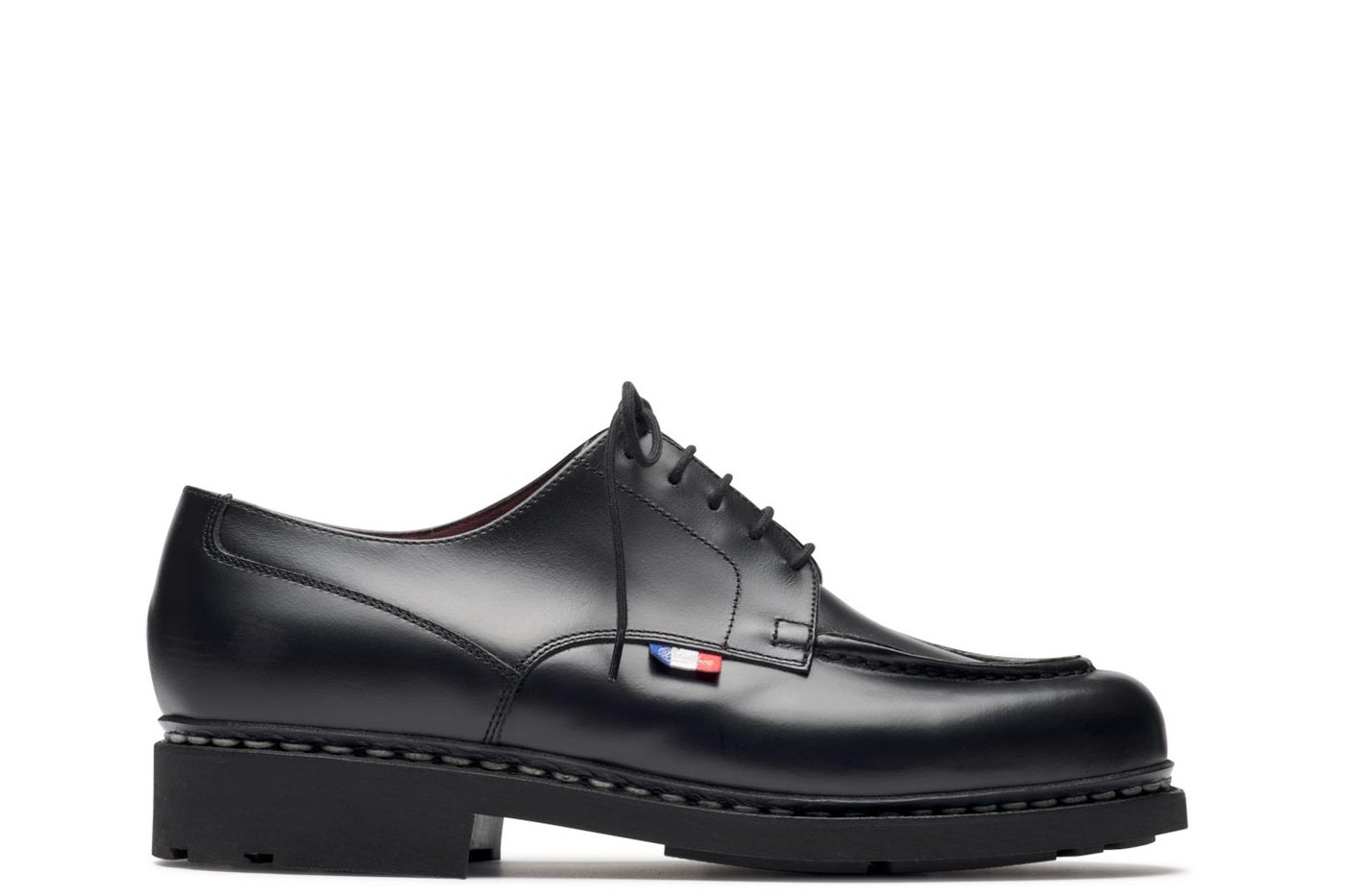
The Chambord: the tailored, weather-defying U-tip
For those whose daily wardrobe leans slightly more towards classic tailoring, the Chambord represents the ideal convergence of French country utility and smart-casual versatility. Built on a traditional five-eyelet derby pattern, it is inspired by historic French 'golf' and field shoes.
The Chambord is characterised by its distinctive stitched U-tip apron, finished with a classic 45-degree angle join at the toe cap. Known in master cordwaining as a pinched-seam apron (jointure bord à bord), this detail demands precise hand-guiding through the stitching machine. Paired with the slightly more refined Tex rubber sole, the Chambord provides a narrower, more conventional dress-shoe profile from above than the broad Michael.
This balance makes the Chambord one of the most versatile all-weather shoes available. It pairs effortlessly with tailored navy chinos, bespoke flannel suits, or knitwear, providing complete puddle-proof confidence without ever appearing excessively casual.
Understanding Lis leather: wax blooming, maintenance and weather resistance
Much of Paraboot’s renowned weather resistance stems from their signature leather: cuir lisse (commonly referred to as Lis leather). Sourced from premier French and European tanneries, Lis is a heavy, full-grain French calfskin subjected to an intensive fatliquoring process, thoroughly impregnated with natural tallows, oils, and beeswax.
First-time Paraboot buyers often encounter a startling phenomenon: upon opening a fresh shoe box or after exposing the shoes to winter chill, a powdery, chalky white haze appears across the leather surface. Far from being mildew or a manufacturing defect, this is natural wax 'bloom' (or efflorescence). It occurs when ambient temperatures drop and the rich interior fats crystalise, migrating slightly towards the grain surface.
Addressing the bloom requires no soaps or detergents. Simply rubbing the surface with a soft flannel cloth or buffing vigorously with a natural horsehair brush generates enough frictional warmth to melt the waxes back into the pore structure, leaving behind an exceptionally deep, luminous glow. Because Lis leather is already packed with moisture-resistant oils, it requires minimal ongoing intervention: a light wax polish or balanced conditioning cream applied every few months is sufficient. Heavy neatsfoot or mink oil should be strictly avoided, as it can oversaturate the fibres and cause premature leather softening.
Sizing, volume and the break-in curve: what to expect
Navigating Paraboot sizing requires careful consideration of volume, as both the Michael and Chambord fit very differently from standard English or American heritage boots.
The Michael is built on an exceptionally generous, high-volume last with a wide, blunt toe box. Because the two-eyelet closure provides limited tension across the midfoot, buying your true sneaker size or standard British dress shoe size will almost certainly result in severe heel slippage. Most wearers find their ideal fit by stepping down a half to a full size from their typical UK or EU sizing (for instance, a standard UK 9 / EU 43 wearer will often take a UK 8 or 8.5 in the Michael). Wearers with low insteps or narrow heels frequently benefit from adding a slim vegetable-tanned leather insole or pairing them with medium-cushion wool socks.
The Chambord presents an almost opposite fitting challenge: while its forefoot is moderately snug, its instep is engineered with considerable vertical height. If you possess a high instep, the Chambord fits comfortably; however, individuals with flatter feet may find the facing closes completely without locking down the heel.
Prospective owners should also prepare for a substantial break-in period. The combination of thick 2.2mm calfskin, a dense leather midsole, a heavy Norwegian welt, and vulcanised rubber outsoles means the sole unit is exceptionally rigid out of the box. During the initial 10 to 15 wears, slight heel slippage is normal while the sole unit learns to flex. Furthermore, at approximately 650g to 720g (23oz to 25oz) per shoe, they are heavy footwear—designed for deliberate, stable striding rather than athletic lightness.
Resoling and long-term repairability: keeping Paraboot on the road
One of the most compelling arguments for investing in Norwegian-welted footwear is longevity. Because the turned-out upper is anchored to an independent insole rib, a skilled cobbler can remove the worn vulcanised outsole and midsole repeatedly without disturbing the structural integrity of the shoe's upper or internal lining.
Paraboot operates its own official restoration and resoling service at their factory workshops in Saint-Jean-de-Moirans. When sent back to the manufacturer through an authorised stockist, shoes receive an authentic factory rebuild: the original insole and upper are inspected, a fresh natural rubber sole (Marche II, Tex, or Griff II) is vulcanised and stitched on identical original machinery, and the leather is cleaned, nourished, and re-blocked to shape.
For owners seeking local resoling, any competent heritage cobbler equipped with a Goodyear/Norwegian stitcher can undertake repairs. While sourcing proprietary Paraboot-branded sole units independently is difficult, standard high-grade alternatives—such as Vibram 2070 Trent, Vibram Eton, or Dainite studded rubber outsoles—pair seamlessly with the shoe's substantial silhouette. The key maintenance priority is caring for the exposed welt stitching: keeping the welt line free of road salt and applying a light dab of neutral wax polish protects the structural flax threads from rot.
Practical buyer recommendations and final verdict
Choosing between Paraboot’s flagship derbies ultimately hinges on your personal aesthetic and foot anatomy:
At retail prices ranging between £420 and £485 (€480 to €540), Paraboot represents a significant investment. Yet with their proprietary in-house French rubber soles, indestructible Norwegian welts, and rich Lis calfskin, both the Michael and Chambord are shoes capable of providing decades of dependable, stylish service when cared for properly.
- Select the Michael if: You favour relaxed tailoring, wide-leg denim, and workwear silhouettes; you have average-to-wide feet and appreciate a spacious toe box; and you want a distinctive, tactile heritage shoe that makes a confident visual statement.
- Select the Chambord if: Your wardrobe leans toward smart-casual sports jackets, chinos, and tailored trousers; you need an impenetrable wet-weather commuter shoe that fits seamlessly into office environments; and you have a normal-to-high instep.
Quellen & weiterführende Links
- Paraboot: Official history, manufacturing heritage and Norwegian welt specifications
- Paraboot: Michael derby official product specifications
- Paraboot: Chambord derby official product specifications
- Paraboot: Michael in Fauve tumbled leather specifications
- Society of Leather Technologists and Chemists: Principles of heavy fatliquored leathers and water repellency